Enhancing Road Safety Through Clear Markings
Pavement markings are essential for guiding drivers and promoting road safety. They signal right-of-way, cautions, and traffic lanes, reducing confusion at intersections and facilitating orderly merging and lane changes. Clearly marked pedestrian crossings ensure safe spaces for pedestrians and drivers are alerted to yield points, preventing misunderstandings and danger.
Pavement markings are crucial for safety and efficiency in urban and suburban traffic networks. Upgrading long-life pavement markings can reduce lane-departure crashes by up to 13%, especially in rural areas where lane departure is a leading cause of accidents. Regular maintenance not only improves safety but also enhances the day-to-day driving experience for all road users. Investment in consistent pavement marking maintenance can significantly reduce accident likelihood and improve the overall safety of road users. Specialists like paving solutions San Diego CA provide expert services to keep markings in optimal condition, contributing to safer and more predictable streets.
Durability and Cost-Effectiveness of Thermoplastic Markings
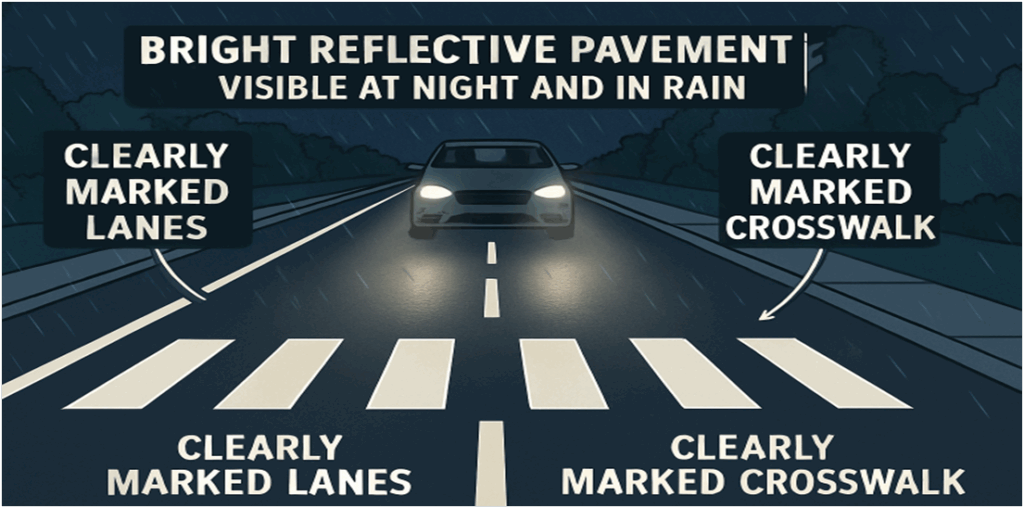
Thermoplastics are a significant advancement in pavement marking materials, offering a longer lifespan than traditional paint. These markings can last between five and seven years under typical road conditions, reducing maintenance cycles, downtime for repainting projects, and temporary road closures. Although the initial investment is higher than conventional paint, the extended service life leads to significant savings in labor and material costs over the long term. Municipalities and agencies that switch to thermoplastics often find that the decreased need for continuous re-striping allows budget resources to be allocated elsewhere, supporting additional infrastructure needs or improvements. The overall lifecycle cost of thermoplastic markings is lower than conventional options, reinforcing their value for responsible public spending. Modern thermoplastic materials are often embedded with reflective glass beads or retroreflective elements, improving nighttime and low-light visibility, especially during rainy weather.
Supporting Automated Vehicle Technology
As automated and semi-autonomous vehicle technology becomes more prevalent, the importance of well-maintained pavement markings grows. These advanced vehicles use sensors, cameras, and artificial intelligence to interpret and follow road markings, relying heavily on their clarity and consistency. Suppose markings are faded, missing, or inconsistent. In that case, it can cause alignment issues for these systems and, in some cases, might even force the vehicle to disengage its self-driving features entirely, returning control to the human driver and potentially increasing risk.
By investing in robust, high-visibility pavement marking solutions, communities not only make roads safer for today’s drivers but also ensure that their infrastructure is ready for evolving transportation needs. This proactive approach supports the integration of emerging technologies and helps maintain high safety standards into the future. The Minnesota Transportation Research Board emphasizes the link between modern road markings and the effectiveness of automated vehicle technologies, highlighting that clear, consistent lane edges are essential for both current and next-generation transportation systems.
Environmental and Safety Considerations
Environmental responsibility is crucial in transportation infrastructure decisions, with durable materials like thermoplastics being more environmentally friendly. They require less frequent application, reducing manufacturing, transportation, and application cycles, resulting in lower raw material use, fewer emissions, and less disruption to local air quality. Well-maintained road markings also help reduce idling and unnecessary braking, contributing to a community’s carbon footprint. Pedestrian safety is also improved by clearly marked crosswalks, bicycle lanes, and school zones, benefiting children, families, and cyclists. A comprehensive approach to road marking maintenance is essential for building safer, more sustainable communities.